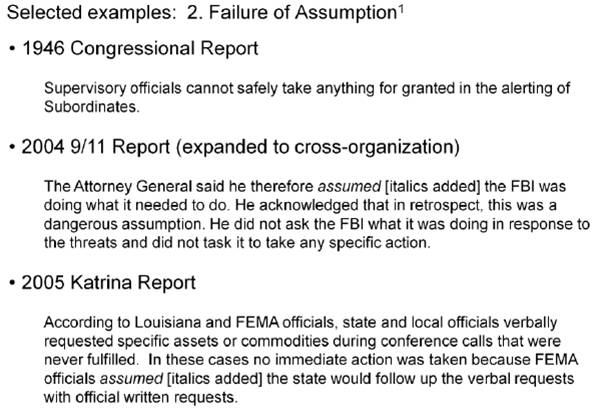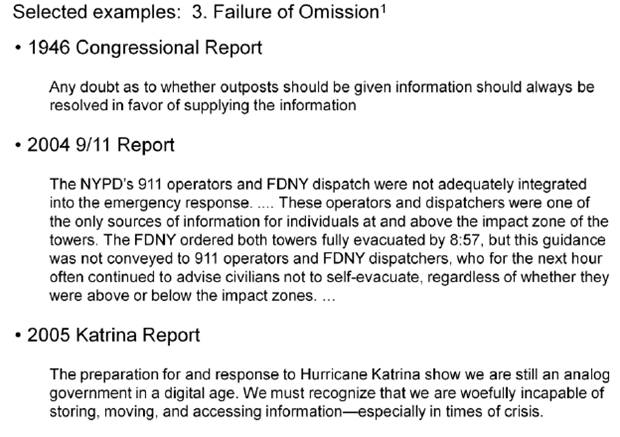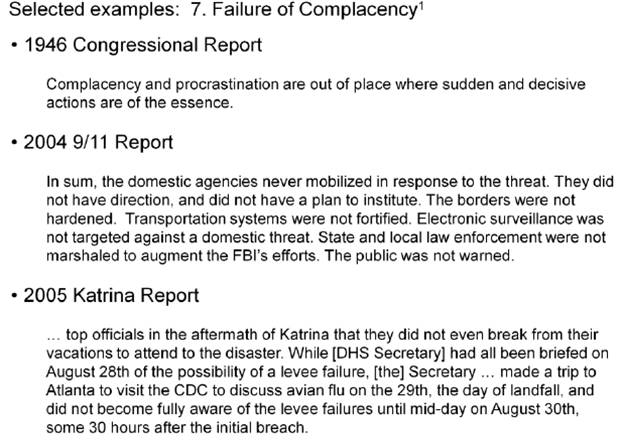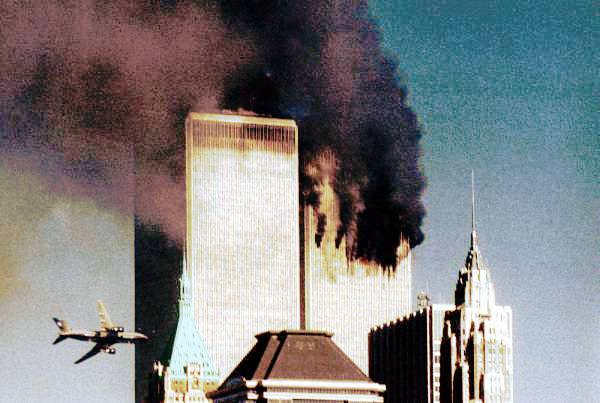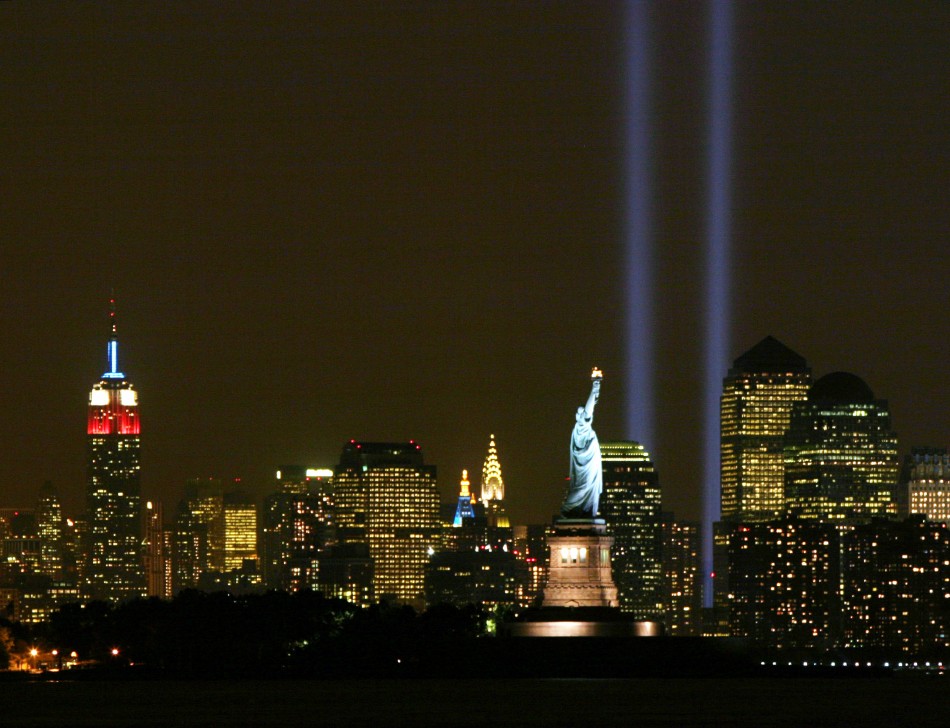
As the day closed on September 11 2001, we began the process of “doing what we know”- we had been attacked – strangely suprising to some in other lands, Americans strike back hard when treaded upon – so we went to war in the way we know how. The events of September 11, 2001 were of such magnitude, shock and so far outside the norm of how we perceived warfare, and our whole intelligence process was so much still Cold War mind set, we didn’t “know what to do” …really. We attacked, we fought, we used B-52s and smart bombs with special forces guys doing the targeting and riding with Afghans on horses. We learned, but we were still doing what we know not knowing what to do.
After the invasion of Iraq, that became apparent - who exactly were we fighting, how many groups, were they connected? We learned, the hard way. Army General Petraeus and Marine General Mattis rewrote the counterinsurgency manual – many had long fought even using the term insurgency. Americans fought, Americans died, some learned. But it has been a tough think. What kind of war have we been fighting: guerrilla warfare, non conventional, unconventional, fourth generation, irregular? Is the answer counterinsurgency, counterterrorism, what? The debate on whether what applied in Iraq applies in Afghanistan still ebbs and flows – below the surface for most Americans.
It’s gets hard when the protagonist stop wearing blue and red uniforms to understand the true nature of warfare. Yet, old principles still abide, Clausewitz’s trinity does indeed still hold:
- primordial violence, hatred, and enmity, which are to be regarded as a blind natural force;
- the play of chance and probability within which the creative spirit is free to roam;
- element of subordination, as an instrument of policy, which makes it subject to reason….”
(This set of elements is usually labeled “emotion/chance/reason”; sometimes “violence/chance & probability/rational calculation”; or, even more abstractly, “irrationality/nonrationality/rationality.”)
So questions still persist; Are we better off ten years later, have we gained the imagination so lacking pre 9-11, are our leaders really prepared to make the decisions necessary in a world so ill defined, indeed, are we capable of knowing what to do rather than doing what we know?
Like most Americans over the past week I’ve searched the blogs, read the opinion pieces, the stories of the folks most directly involved, watched hours of commentators and ceremonies and dedications. I’ve searched and struggled to find words for this blog, given the focus on decision making in severe crisis.
Below are three articles and links to the originals that surround the idea of learning and focusing so that we as a people – top to bottom – can know what to do. They are well worth your time.
One introductory comment, then the rest stand on their own needing no help from me. The first article is about Rick Rescorla. His story has been featured here before. (See Sheepdog of Morgan Stanley) He may be the only person who knew what to do on September 11 2001. Learning from the first WTC attack, he prepared those at Morgan Stanley for what he was sure would be another attack. Ignoring Port Authority notice to remain in place after the attacks, he evacuated Morgan Stanley employees. Were it not for him, the losses at the twin towers would have been not 2800 but 5300.
Knowing what to do is possible – it takes constant learning and the will to stay the course. Day is done, what next?
Late Sunday, June 1st, 2001, my wife, Caroline and I pulled into the front of Rick and Susan Rescorla’s condo. In keeping with his ebullient personality, Rick had hung his signature First Cavalry jacket on the porch light. Always larger than life, he bounded down the steps with a welcoming smile and bear hug.
He was that kind of guy, absolutely fearless and totally selfless.
A singer of songs in the face of the enemy, he calmed his men on Landing Zone X-ray as they awaited a North Vietnamese attack at dawn–and later after the attacks of 9/11.
That was Rick. Big guy–must have been over 6’2”, Bunyanesque in life. He was a hero to all of us, fellow lieutenants and enlisted.
In Vietnam, while serving with the 2nd Battalion 7th Cavalry in 1965, he invented what became officially known as the LURP team. And later, he was featured on the cover of We Were Soldiers Once…and Young.
In later years, I got to know Rick as a man of insatiable scholarly curiosity and intellect as well as a father.
We occasionally exchanged small tokens like knives or articles with one another. All who knew him were amazed at his generosity. As we left following dinner that June night, Rick handed me something in an expensive cloth bag. He knew I had spent my career in the box business. He said, “Look at it later.”
Ten years ago on September 11th, at about 6:30 pm, I made the hardest phone call I ever made in my life–to Rick Rescorla’s wife Susan.
I hoped against hope that he had not gone to work that day in the World Trade Center. I hoped he and Susan had taken the opportunity to enjoy one of their day trips to the Jersey countryside. But somehow deep down inside, I knew I had lost a friend.
Inside that bag he had given me that June was a beautiful wooden box, the kind you keep on your dresser, with your watches, your precious jewelry, and your memories. His box is still on my dresser and not a day goes by that I don’t thank God for the privilege of counting Rick Rescorla as a friend.
Later that winter, I visited Susan and she took me to the Raptor Center to show me the living memorials she had endowed in Rick’s memory. There were two American Bald Eagles that had been rescued from injury. How perfect and magnificent they were–sitting proudly on their perches, so like Rick. Survivors. Poised. Erect. Unbroken. The message in their eyes: “We Will Never Surrender.”
Rick, head of security for Morgan Stanley, managed to evacuate the 2500 employees of the South Tower on 911. There are photos of him singing to calm the evacuees. Rick was last seen climbing back up the stairs to make a final sweep before the building collapsed.
Rick’s physical remains have never been recovered but his spirit will never die.
His statue is now permanently placed on the grounds of the National Infantry Museum along with a piece of steel from the building.
Ten years ago a petition began to circulate calling for him to receive the Presidential Medal of Freedom. It went viral and garnered thousands of names. Conversations with the White House staff were held, but nothing ever came of it. Now, as we pause to recall those who stood up on 911, there is a pall cast by the lack of recognition of Rick’s valorous sacrifice.
Those of us who knew Rick and served with him in combat are still trying to see that he gets the national recognition he deserves. He has been honored in his native England, his hometown of Cornwall, and by his friends who contributed to the Columbus Georgia memorial.
The man who saved more people on one day by his actions has not been awarded the Presidential Medal of Freedom.
If he had been fighting on foreign soil, he would have received the Congressional Medal of Honor. Damn shame ten years later, our leaders have not honored this immigrant citizen who so magnified our American values.
CP Note: *Watch “Voice of the Prophet,” an interview with Rick Rescorla, done with Robert H. “Bob” Edwards’ son Robert Edwards, who fought at Ia Drang with Rick. In the interview, Rick all but predicts the attacks of 9/11.
By Mark Safranski at ZENPUNDIT
Ten years ago to this day, almost to the hour of which I am writing, commercial jetliners were highjacked by al Qaida teams armed with boxcutters, under the direction of Mohammed Atta, were flown into the towers of the World Trade Center and the Pentagon. A fourth plane, United Airlines Flight 93, believed to be headed to the US Capitol building, crashed in Pennsylvania when passengers led by Todd Beamer heroically attempted to stop the highjackers. The whole world watched – most with horror but some with public glee - on live television as people jumped out of smoke-engulfed windows, holding hands, to their deaths. Then, the towers fell.
From this day flowed terrible consequences that are still unfolding like the rippling shockwave of a bomb.
We look back, sometimes on the History Channel or some other educational program, at the grainy, too fast moving, sepia motion pictures of the start of World War I. The crowds wildly cheered troops with strangely antiquarian uniforms that looked reminiscent of Napoleon’s day, march proudly off to the war that gave Europe the Somme, Gallipoli, Passchendaele and Verdun. And the Russian Revolution.
After the armistice, the victors had a brief chance to reset the geopolitical, strategic and economic patterns the war had wrought and in which they were enmeshed. The statesmen could not rise to that occasion, failing so badly that it was understood even at the time, by John Maynard Keynes and many others, that things were being made worse. World War I. became the historical template for the short but infinitely bloody 20th century of 1914-1991, which historians in future centuries may simply describe as “the long war” or a “civil war of western civilization”.
There is a serious danger, in my view, of September 11 becoming such a template for the 21st century and for the United States.
On the tenth anniversary of 9/11, as we remember the fallen and the many members of the armed services of the United States who have served for ten years of war, heroically, at great sacrifice and seldom with complaint, we also need to recall that we should not move through history as sleepwalkers. We owe it to our veterans and to ourselves not to continue to blindly walk the path of the trajectory of 9/11, but to pause and reflect on what changes in the last ten years have been for the good and which require reassessment. Or repeal. To reassert ourselves, as Americans, as masters of our own destiny rather than reacting blindly to events while carelessly ceding more and more control over our lives and our livelihoods to the whims of others and a theatric quest for perfect security. America needs to regain the initiative, remember our strengths and do a much better job of minding the store at home.
The next ninety years being molded by the last ten is not a future I care to leave to my children. I can think of no better way to honor the dead and refute the current sense of decline than for America to collectively step back from immersion in moment by moment events and start to chart a course for the long term.
Pull out the chocks. Let’s roll
Say what you will about the messenger, but “Courtney” was right. September 11th was a watershed event for an entire generation of Americans; one which would dominate their worldview for much of their adult lives.
Sure, some might scoff at the jubilant crowds gathered around the White House after news leaked of Osama bin Laden’s demise at the hands of US Navy SEALs. But while September 11th may not have been as militarily significant as, say, Pearl Harbor, it was no less visceral: New York and Washington weren’t mere US territories thousands of miles from the shores of the US, as was Hawaii in 1941. The Pentagon and World Trade Center were fixtures in the lives of everyday Americans; and in the 21st Century, live footage of the conflagration could be piped into every home in America in vivid color. And though only a tiny portion of America would serve in uniform in the decade to come, the effects of the attacks would permeate nearly every aspect of our lives: the economic downturn, terror alerts, airline security, even the ubiquitous news ticker, now a staple on nearly every cable news station.
But above all, there was the culture of fear.
Osama bin Laden, for all of his malfeasance, certainly didn’t pose the same existential threat to the United States as Imperial Japan, Nazi Germany or the Soviet Union. Yet, his escape from the wrath of the US military, and his wraith-like presence for nearly a decade gave him the allure of a boogeyman. And, like many boogeymen, simply whispering “Osama bin Laden” or “9/11? could frighten and cajole Americans into rash and irrevocable actions: torture at Guantanamo, the invasion of Iraq, and trillions sunk into wasteful security programs.
Yet, for all our mistakes, al-Qaeda erred even greater.
The invasion of Iraq might have been a massive recruiting boon for al Qaeda and its Iraqi affiliate, but by the end of 2006, the organization had overplayed its hand. Local sheiks, and even former al-Qaeda members eventually joined US forces in a counter-offensive against al-Qaeda in Iraq, having been sickened by the violence unleashed by Zarqawi and his minions. The movement, dubbed “The Awakening”, was seen by many as a turning point in the war in Anbar Province.
Meanwhile, in Pakistan, remotely-piloted drones pounded away at the Federally Administered Tribal Areas, keeping senior al-Qaeda figures at bay. Finally, the organization was dealt a deadly blow when US Navy SEALs mounted a spectacular raid into a compound in Abbotabad, Pakistan, killing the former al-Qaeda leader who had spent nearly a decade presumably under house arrest, under the watchful eye of the Pakistani government. Months later, a fierce drone campaign picked off al-Qaeda’s number two operative.
And though US officials are rightly cautious over alleged terror plots timed to coincide with the tenth anniversary of 9/11, they’re nowhere near the size or scope of 9/11.
Reduced to underwear bombs, al-Qaeda is a mere shell of its former self.
But though we may have crippled al-Qaeda, we’ve been weakened, too. Thousands of American troops have been killed in wars abroad, and tens of thousands more have been horribly wounded. Our national debt has surpassed fourteen trillion dollars–roughly our yearly Gross Domestic Product. Unemployment is rampant, and our collective confidence is shattered. Our public image has been bruised, and partisan rancor cuts so deeply that we cannot even agree upon a decent memorial to commemorate the victims of 9/11, even ten years later.
As a nation we can be shallow, petty, and selfish. But deep down, we can learn to sacrifice and cooperate.
Shortly after the attacks of September 11th, our rallying cry was “Let’s roll”: a call not just to punish the perpetrators of this odious act–rightly so–but also to rebuild.
Ten years later, it’s time to start rebuilding. For nearly a decade, our national wheels have been chocked with pernicious emnity and fear mongering. It’s time to finally pull out the chocks and roll.
Tags: Culture of Preparedness, resilient communities